
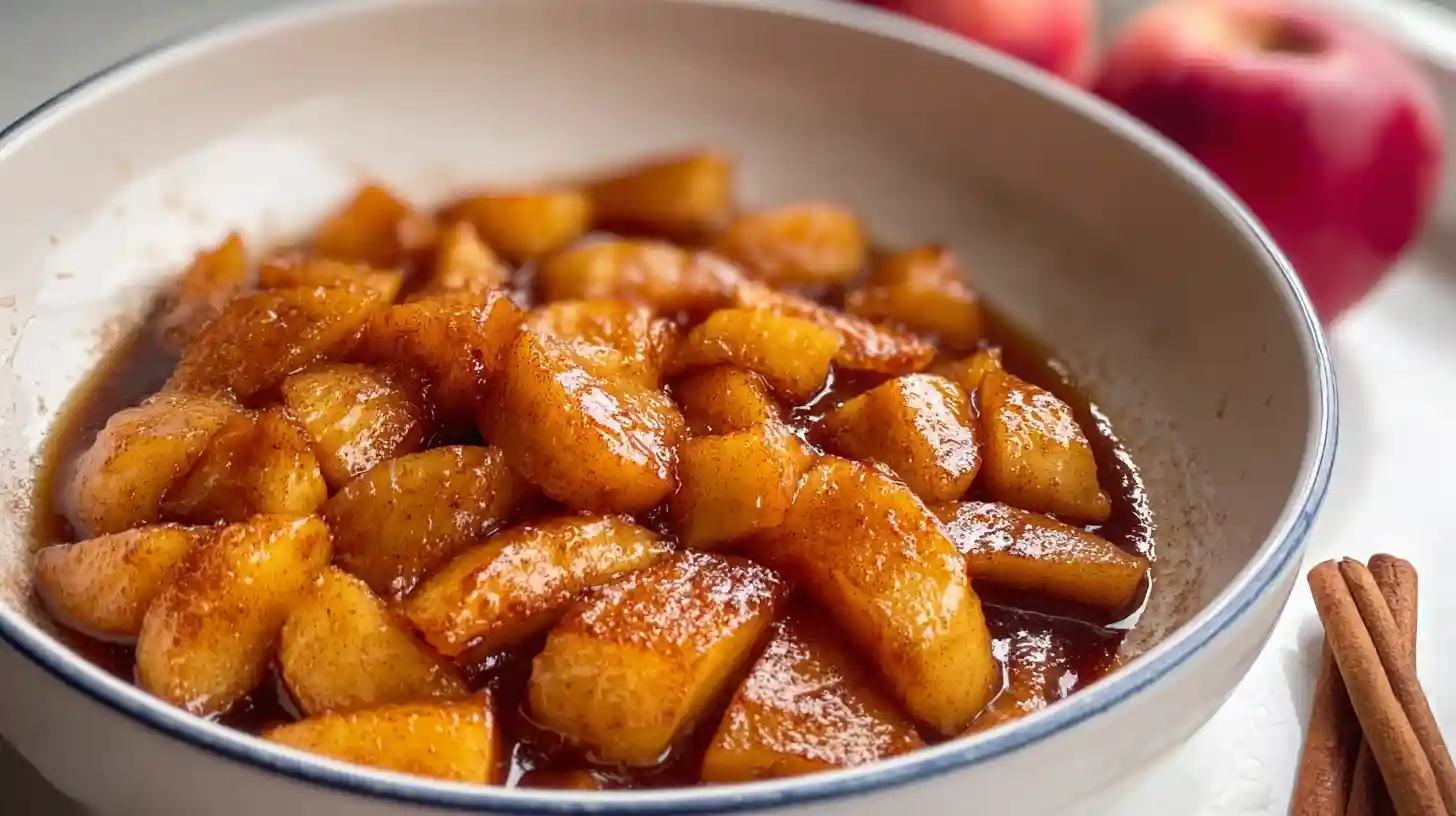
Butter, brown sugar, cinnamon, and a handful of sliced apples in a hot skillet. That is the whole setup for Cinnamon Fried Apples, and in about 15 minutes you have something that works over pancakes, alongside roasted pork, or just eaten straight from the pan with a spoon. The sauce that forms as the apples cook is glossy, thick, and deeply spiced without being overly sweet. It is the kind of recipe that sounds too simple to bother writing down, but the details on apple variety, slice thickness, and heat level are what separate a perfectly tender batch from a mushy or undercooked one.
Getting this right consistently is less about following steps and more about understanding what you’re looking for at each stage of the cook. The notes below cover exactly that.
Cinnamon Fried Apples Ingredients
- 4 medium apples, peeled, cored, and sliced 1/4 inch thick, about 4 cups total
- 3 tbsp unsalted butter
- 3 tbsp packed light brown sugar
- 1 tbsp granulated sugar
- 1.5 tsp ground cinnamon
- 1/4 tsp ground nutmeg
- 1/4 tsp fine salt
- 2 tbsp apple cider or apple juice
- 1 tsp pure vanilla extract
- 1 tsp maple syrup, optional for maple cinnamon fried apples
- 1 tsp cornstarch mixed with 1 tbsp cold water, optional for thicker sauce
The Right Apple and Why Slice Thickness Matters
For pan fried apples easy enough to make on a weeknight without second-guessing the result, the apple variety is the first decision that matters. Honeycrisp, Fuji, and Braeburn hold their shape through the full cook time and produce defined, tender slices rather than collapsing into sauce. Granny Smith adds a sharp tartness that contrasts nicely with the sweet brown sugar and is the best choice if you want the sauce to taste more complex and less one-dimensionally sweet. McIntosh and Red Delicious both break down too fast and produce applesauce texture before the sauce has time to develop any real body.
Slicing to a consistent 1/4 inch is important for even cooking. Thicker slices stay firm in the center while the edges soften, and thinner slices overcook before the sauce reduces properly. A mandoline makes consistent cuts easy, but careful knife work gets the same result. For a fried apple recipes approach that uses two varieties at once, half Granny Smith and half Honeycrisp produces a more layered flavor than a single-variety batch and is worth trying after the first straightforward version.
How to Make Cinnamon Fried Apples Step by Step
Melt the butter fully before adding apples. Butter that hasn’t fully melted causes uneven browning across the pan and the apples nearest the unmelted patches steam instead of developing color. Medium heat is the right starting point. High heat caramelizes the sugar too fast and burns the edges before the apple centers soften.
- Melt butter in a large skillet over medium heat until fully liquid and beginning to foam. Watch for it to settle, which signals it is hot enough to add the apples.
- Add apple slices in a single layer if the pan allows. Do not stir immediately. Let them sit undisturbed for 2 minutes so the cut surfaces pick up some light golden color from direct contact with the hot butter. Stir once and cook another 2 minutes.
- Sprinkle both sugars, cinnamon, nutmeg, and salt evenly over the apples. Stir to coat every slice. The sugars will begin melting into the butter within about 30 seconds and the pan will become fragrant quickly.
- Add apple cider and vanilla. Stir gently and reduce heat to medium-low. Cook for 5 to 7 more minutes, stirring every couple of minutes, until apple slices are fork-tender and the liquid has reduced into a glossy sauce that clings to each piece. The sauce should coat the back of a spoon and not look watery at all.
- If the sauce looks too thin at the end, stir in the cornstarch slurry and cook for 1 more minute until it tightens. Remove from heat immediately after the sauce reaches your desired consistency.
- Stir in maple syrup if using. Serve warm directly from the skillet.
Troubleshooting Sauce and Texture Problems
Watery sauce that won’t reduce usually means the heat dropped too low during the last few minutes of cooking or the apples released more juice than expected. Raise the heat back to medium and cook uncovered, stirring gently, for 2 to 3 extra minutes. Very juicy apple varieties contribute more liquid than firm ones, which is another reason firm varieties produce a more reliable result in this homemade fried apples recipe. If the sauce is still loose after that extended cook time, the cornstarch slurry is the cleanest fix, fast and effective without changing the flavor of the finished dish at all.
Mushy apples with no defined texture usually mean the slices were cut too thin or the heat ran too high throughout cooking. The correct result is tender but with enough structure that you can still distinguish each slice on a fork. If the batch goes soft, serve it over ice cream or oatmeal where the texture works rather than fights the dish. For the next batch, increase slice thickness slightly and keep heat firmly at medium from start to finish.
Variations Worth Making
Maple cinnamon fried apples swap the granulated sugar for 1.5 tablespoons of pure maple syrup and produce a slightly richer, more complex sauce that takes about 2 extra minutes to reduce because of the added liquid. The maple flavor is subtle but distinct and works particularly well when serving the apples over waffles or alongside breakfast sausages. For easy crockpot fried apples with no skillet involved, layer the same ingredients in a slow cooker and cook on low for 3 to 4 hours, stirring once at the halfway point. The texture is softer than the skillet version but the flavor is nearly identical and the hands-off approach makes it practical for morning prep.
How to Store and Serve
Store cooled cinnamon fried apples in an airtight container in the refrigerator for up to 4 days. The sauce thickens considerably when cold. Reheat in a small saucepan over low heat with a teaspoon of apple cider or water to loosen it as it warms, stirring gently to prevent the bottom from scorching. They work over pancakes, waffles, French toast, oatmeal, vanilla ice cream, or alongside roasted pork tenderloin or pork chops. For a simple how to make fried apples dessert presentation, spoon a warm portion into a small ramekin and top with a tablespoon of whipped cream and a dusting of extra cinnamon. Freezing is not recommended since the apple texture breaks down significantly after thawing and the sauce separates.
FAQ
Do the apples need to be peeled?
Peeling is recommended for the smoothest texture since apple skin remains slightly chewy even after the flesh beneath it becomes tender. That textural mismatch is noticeable enough to affect the eating experience for most people. If you prefer to leave the skin on for added texture or convenience, use slightly thinner slices and add 1 to 2 minutes to the total cook time since the skin acts as a mild barrier to heat reaching the flesh. The flavor is not affected either way, so leaving the skin on is a fully valid choice for a fries apples recipe situation where speed matters more than a perfectly smooth bite.
Can I use coconut oil or another fat instead of butter?
Coconut oil is the most effective substitute and produces a comparable richness to butter in the pan, with a faint coconut undertone that blends reasonably well with cinnamon and apple. Use the same 3-tablespoon quantity. Vegan butter sticks work nearly identically to dairy butter in both flavor and sauce consistency and are the better choice if you want the taste to stay as close to the original as possible. Avoid light olive oil or vegetable oil since neither has enough flavor or fat structure to build the glossy, cohesive sauce that makes how to fry apples in a skillet worth doing compared to simply simmering apples in water with sugar.
What is the best apple variety for this recipe?
Honeycrisp is the most reliable single-variety choice for consistent texture and natural sweetness that doesn’t need much added sugar. Fuji and Braeburn are close seconds. Granny Smith is the best option for a tarter result with more sauce complexity. Mixing two varieties, one sweet and one tart, is worth doing once you have made the single-variety version and want more depth in the flavor. The combination of Honeycrisp and Granny Smith in equal proportions produces what many people consider the most balanced version of this recipe for fried apples with a sauce that tastes noticeably more layered than any single variety produces on its own.
Can I make a larger batch for a crowd?
Yes, but cook in two separate skillets rather than doubling the batch in one pan. Overcrowding a single skillet with too many apple slices traps steam and the apples stew rather than developing any color or caramelization. The sauce also takes much longer to reduce when there is too much liquid in the pan from a double batch of fruit. Two skillets running simultaneously keep each batch at the right thickness and texture. For easy crockpot fried apples that scale up more naturally, a doubled or tripled batch in a large slow cooker avoids the crowding issue entirely and handles larger quantities without any quality loss.
What can I serve these with besides ice cream?
Thick buttermilk pancakes or French toast are the most natural pairings for a breakfast setting. Stirred into plain oatmeal with a spoonful of almond butter, they turn a basic bowl into something genuinely satisfying. Spooned over a slice of pound cake or angel food cake, they work as a plated dessert that requires almost no additional effort. For a savory pairing, warm cinnamon fried apples alongside a seared pork chop or pork tenderloin is a classic combination across American and European cooking traditions. The sweetness of the sauce balances the savory richness of the pork in a way that makes both elements taste better together than either one does on its own.
Cinnamon Fried Apples
Ingredients
Equipment
Method
- Melt butter in a large skillet over medium heat until foamy and fully liquid.
- Add apple slices and cook undisturbed 2 minutes. Stir once and cook 2 more minutes until edges begin to color.
- Sprinkle both sugars, cinnamon, nutmeg, and salt over apples. Stir to coat every slice evenly.
- Add apple cider and vanilla. Reduce heat to medium-low and cook 5 to 7 minutes, stirring occasionally, until apples are fork-tender and sauce is thick and glossy.
- Stir in cornstarch slurry if needed and cook 1 minute to thicken. Add maple syrup if using. Remove from heat and serve warm.
Notes
- Use firm apple varieties – Honeycrisp, Fuji, Braeburn, or Granny Smith. Soft varieties like McIntosh break down too quickly in the skillet.
- Slice apples to a consistent 1/4 inch for even cooking throughout the batch.
- Cook apple slices undisturbed for the first 2 minutes to build light color rather than steaming them.
- If the sauce looks thin at the end, add the cornstarch slurry and cook 1 minute – remove from heat immediately after it tightens.
- Reheat leftovers with a teaspoon of apple cider over low heat to loosen the sauce which thickens considerably when cold.